Property Tax Liens in Kentucky
In Kentucky, if you do not pay your property taxes, you could lose your home. There are several steps in this process that can be scary and confusing for many people. This article will start with a basic overview and then provide more detail and some frequently asked questions to help homeowners protect their property.
The process starts when a property owner misses the deadline to pay their taxes. Then there are late payment penalties and interest charges. Around August each year, each county conducts a sale of the overdue tax bills from the prior year. A private purchaser of a property tax bill can try to collect the bill and gets certain additional fees. If the homeowner still does not pay after another deadline, then the tax bill purchaser can file a foreclosure case in court which can lead to the loss of the property.
In order to help homeowners to keep their property, these steps are described in greater detail below, together with general tips for homeowners at each step.
1. Best Practices for Avoiding Property Tax Problems: Pay your property taxes on time and apply for any exemptions you qualify for.
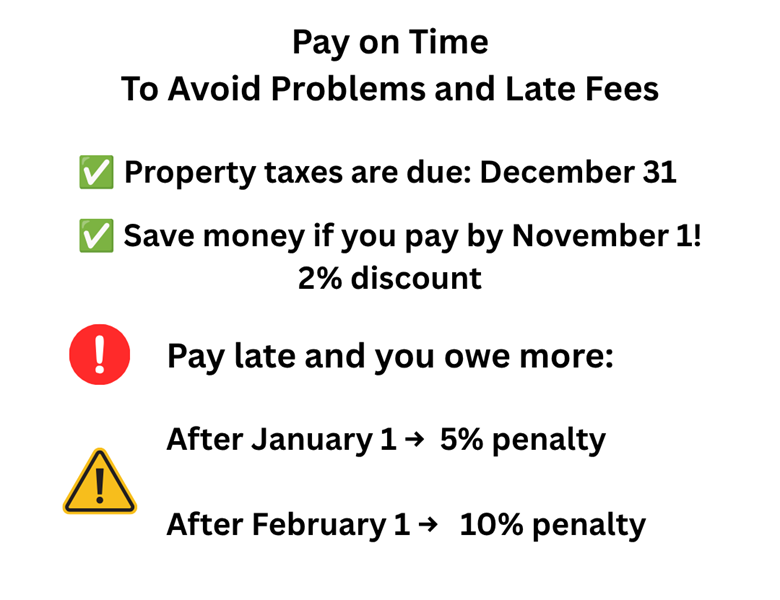
Tax Deadlines and Discounts or Penalties
All of the bad situations described below are completely avoidable if homeowners pay their property taxes on time. The deadline for paying real property taxes in Kentucky is December 31 of each year. (“Real property” means land and any permanent structures attached to it.)
Property owners can get a 2% discount if they pay their taxes in full by November 1 of the assessment year.
There is also a 5% penalty if property taxes are paid between January 1 and January 31 of the year following the assessment year, or a 10% penalty for taxes paid after January 31 of the year following the assessment year. (KRS 134.015) In other words, the difference between paying by November of the tax year versus the following February is 12%, a major difference over a few months. For example, a $1,000 tax bill goes from $980 to $1,100 quickly.
Working with Your PVA and Applying for the Homestead Exemption
To make sure that you are receiving the tax bill, you should make sure that the Property Valuation Administrator (PVA) for the county where the property is has an accurate mailing address. The PVA is a locally elected government official with their own office. You can check how the PVA values your property, and if you think it is too high, you can ask for an adjustment.
Kentucky also has valuable exemptions for elderly and disabled homeowners. If you or your spouse are over 65 or have been found disabled by a federal or state program, you should apply for a “homestead exemption” using Form 62A350. Keep in mind though that these adjustments or exemptions will only affect current or future years and will not affect an existing property tax bill. (KRS 132.810)
2. Property Tax Problems Escalate: The government assesses penalties and fees for late payment.
In addition to the 5% or 10% penalty described above, state and local taxing authorities can add other penalties and interest to a tax bill after the January 31 late payment deadline.
This includes:
- fees for the sheriff’s office to collect the tax bill,
- extra interest for the delay in payment,
- fees for the County Clerk’s Office,
- as well as other costs (KRS 134.119).
Altogether, these costs can add up to as much or more than the original tax bill.
All of these charges need to be taken seriously because the state and local taxing authorities get a lien for delinquent taxes. A lien is a legal interest in your property that lasts up to eleven years or until the taxpayer pays the taxes plus all interest, penalties, and other costs and fees. (KRS 134.420)
At this point in the process, taxpayers can often go to the County Clerk’s Office and ask to work out a payment arrangement. After this step, a delinquent taxpayer may have to deal with a private, for-profit business that purchases tax liens.
3. Property Tax Problems Escalate Further: A private tax lien purchaser buys the tax bill from the government.
In most counties, in about August of each year, the County Clerk’s Office conducts an auction to sell delinquent tax bills from the previous assessment year. If a taxpayer has not paid their property taxes plus any applicable fees or costs by this time, then their tax bill could be sold to a private investor. (See 103 KAR 5:180)
When private investors purchase tax bills, they collect what was already owed AND are also entitled to add certain additional costs and fees. These are in addition to the costs and fees that were previously added by the state and local taxing authorities, and include interest, administrative fees, and pre-litigation attorney’s fees. (KRS 134.125) This round of interest and fees typically adds several hundred dollars to the property tax bill.
The purchaser of the property tax bill also receives a lien for the property taxes plus all interest, penalties, and other costs and fees. (KRS 134.490(3)(d)(1)) This lien is equal in priority to the lien for any other taxes owed to the state or local government, meaning that if the property is foreclosed, the government and the private tax lien purchaser are paid from the proceeds before any other interest holder, including the homeowner. This lien continues for up to eleven years after the property taxes originally became delinquent. In short, the private company has a strong position that is legally tied to the property. Even if you have never heard of this company before, you now need to take its position seriously.
4. Property Tax Problems Escalate Further: The private tax lien purchaser attempts to collect.
After the private tax lien purchaser buys a property tax bill, they are required to send certain information to the taxpayer and attempt to collect the debt before filing a foreclosure case. At this point, the company is acting as a debt collector and there are important consumer protections that the company must comply with.
Most importantly, they are required to send two written notices to the taxpayer.
The First Notice that Tax Lien Purchasers Must Send Property Owners
The first notice must be sent within fifty days of the date the tax bill was purchased, which is listed on the tax bill after it is sold. This notice must give the taxpayer a complete listing of the amounts due, as well as other information about the tax bill. (KRS 134.490(1))
If the tax lien purchaser does not send a written notice with the required information, then it could lose the right to collect any further interest or fees in the case, but it still has the right to collect the tax bill plus previously assessed interest and fees.
The Second Notice that Tax Lien Purchasers Must Send Property Owners Before a Court Case
The second notice must be sent to the taxpayer at least forty-five days before the tax lien purchaser files a foreclosure or other collection case. (KRS 134.490(2))
It is required to include all of the information that was required in the first notice. It must also inform the taxpayer that a collection action will be filed if the bill is not paid and that failure to pay could result in substantial additional costs and fees being added to the bill. If the tax lien purchaser has not sent this notice at least forty-five days before filing a collection action in court, then the court case could be temporarily dismissed until the proper notice has been sent.
Both of these notices are required to be sent to the address listed as the property owner’s address in the local PVA office and must include contact information for the tax lien purchaser. (KRS 134.490(3)(a)(1))
If requested by the taxpayer, most tax lien purchasers have to offer a payment plan to allow the taxpayer to pay the taxes, charges, and fees over time, rather than all at once. (KRS 134.490(5)(a)) Because some tax lien purchasers may not follow this requirement in good faith, it may be helpful if the taxpayer keeps a copy of their request for a payment plan or makes a recording of their request for a payment plan.
More generally the company is prohibited from using any unfair, false, misleading, or deceptive practices to collect their debt. If you think that a property tax debt collection company is acting unfairly or harassing you, you should seek an attorney or file a complaint with the Kentucky Attorney General’s Office of Consumer Protection.
5. Property Tax Problems Turn Into Foreclosures.
If the tax lien purchaser fails to obtain payment, then it may file a foreclosure case in court to enforce the tax lien.
The earliest that it may file such a case is one year after the tax bill originally became delinquent. (KRS 134.546) The taxpayer will need to file an answer in the foreclosure case, or the tax lien purchaser will be able to obtain an immediate default judgment. A delinquent taxpayer should strongly consider obtaining the services of an attorney at this point, if they have not done so earlier. The taxpayer’s answer should assert any reasonable defenses to collection of the tax bill. Such defenses could include any failure by the tax lien purchaser to follow the required notice procedures. Keep in mind that participants in court cases must always tell the truth in everything that they file or say in court.
The immediate consequence of a foreclosure case is a larger bill for the taxpayer. When a tax lien purchaser files the foreclosure case, it massively increases the fees and costs that the taxpayer must pay. In some cases, by the time a foreclosure case is filed, the payoff amount to satisfy the tax bill can be hundreds of times the original cost of the taxes.
Also, many tax lien purchasers will try to avoid an installment payment plan after they have filed a foreclosure case, although they are required to offer one if the taxpayer makes the request within a year of when they purchased the tax bill. Without a payment plan, the taxpayer will have to try to come up with the entire payoff amount, which is often several thousand dollars at this point, or face a foreclosure sale. It is therefore highly advisable to pay off the tax bill before the foreclosure case is filed, at the earliest possible step in the tax collection process.
A foreclosure case is an important legal proceeding that can result in permanent loss of the property. You should seek the assistance of an attorney. Additional legal information about foreclosures is available at KyJustice.org/topics/housing/foreclosure.
FAQS
-
What if I cannot afford the tax bill?
- The taxpayer can request an installment payment plan to spread the payments out over a longer period of time. It is usually best to try to work out a payment plan as quickly as possible through local officials at the County Clerk’s Office, Sheriff’s Office, or County Attorney’s Office. If it is too late for that, but the taxpayer makes this request within one year after the tax bill was sold to a tax lien purchaser, then the tax lien purchaser is required to offer a payment plan that lasts at least twelve months. It is important to make payment arrangements as soon as possible, because more fees and costs can continue to accumulate and make the payoff amount far more expensive.
-
What if the tax bill and other fees are for more than what the property is worth?
- This should not happen except for properties with very low values. Property tax bills are typically several hundred to a few thousand dollars, and the fees and costs can add several thousand more dollars to the total tax bill. When the total tax bill exceeds the value of the property, it doesn’t change the options available to the taxpayer. The taxpayer can still ask the tax lien purchaser for a payment plan or try to sell the property to pay off the bill before the foreclosure sale (because a sale through a realtor will typically bring a much higher price than a foreclosure sale). If the property is sold in a foreclosure sale, and it sells for less than the total amount owed on the tax bill, then the tax lien purchaser can try to collect a deficiency judgment for the remainder of the debt from the property owner(s). It can potentially obtain other liens or garnishments to collect the deficiency judgment.
-
Who owes the tax bill if the property owner recently passed away?
- All of the property taxes must be paid in order to avoid the penalties, fees, and other costs described above, and to avoid foreclosure. The heir is personally liable for any tax bill that came due after the death of the prior owner, but keep in mind that the property taxes ultimately need to be paid regardless of personal liability in order to avoid incurring extra costs or foreclosure.
-
Who owes the tax bill for property that is in heirs?
- Each heir is personally liable for the portion of the taxes equal to their share of interest in the property – but always remember that if the taxes aren’t paid there will be additional fees and penalties and the property will eventually be foreclosed. If one owner pays more than their share of the property taxes, then they can seek reimbursement from the other heirs to recover the extra amount that they paid beyond their share.
-
What if I get a tax bill for a property that I already sold?
- If it is for a tax bill that originally became due before you sold it, you may be personally liable for it, meaning that you could be subject to a judgment and garnishments in order to collect whatever is owed on the tax bill. If you get a tax bill that originally became due after you sold the property, then you need to update the contact information for the property owner that is on file with your County Clerk’s Office in order to make sure that they send any further bills to the new owners. You should also contact the new owners to tell them about the tax bill, so that they do not miss opportunities to pay it off before further fees and costs accrue.
-
Are mobile homes considered real property?
- A mobile home can be either personal property or real property. It is usually taxed as part of the real property on which it sits, regardless of whether it has been converted to real property. Personal property is usually moveable things that people own, such as cars, furniture, clothing, or other items. Real property is land or buildings. When a mobile home is manufactured, it is initially personal property titled in the same way as an automobile. Through a legal document called an “Affidavit of Conversion to Real Estate,” it will become part of the real property. Counties often tax it as part of the land anyway. If your mobile home is included in the tax bill, then if there is a foreclosure case to collect the tax bill, it will generally include the mobile home as well.
-
What if the tax bill is for a home that no longer exists?
- The destruction of a home for any reason does not eliminate or otherwise change a property tax bill that is already due. You should try to get the value of your property reappraised if the home is destroyed or significantly damaged and you cannot get it fixed (for example, through your homeowner’s insurance). Speak to the Property Valuation Administrator to ask about getting your property value reassessed for tax purposes. If your property is destroyed, you should work with your home insurance company and seek assistance from FEMA if there is a disaster declaration.
-
What if the foreclosure sale brings in less money than what the tax bill and fees and costs were?
- If the property is sold in a foreclosure sale, and it sells for less than the total amount owed on the tax bill, then the tax lien purchaser can try to collect a deficiency judgment for the remainder of the debt from the property owner(s). It can potentially obtain other liens or garnishments to collect the deficiency judgment.
-
What if the foreclosure sale brings in more money than the tax bill and fees and costs were?
- If the property is sold in a foreclosure sale, and it sells for more than the total amount owed on the tax bill, then there is a priority order to distribute the remaining money. Other liens, such as mortgages and judgment liens, must be paid off first before the homeowner can get any of the money from the sale proceeds. After all of the other interest holders are paid, whatever is left over, if anything, is distributed to the homeowner.
Topics